



Conversion in progress ...
Please wait while we generate your PDF
Smoky Mountain Short-Term Rental Investment Guide

Start With Your Strategy, Not the Listings
Before you look at a single property, get specific about how you intend to use it. A full-time short-term rental investor, a buyer wanting a second home with occasional rental income, and someone buying primarily for personal use with light rental upside are all shopping for different properties, even if they are looking in the same zip code.
Your strategy should also account for your appetite for hands-on management versus hiring it out, how much personal use you want each year, and your tolerance for the ups and downs that come with owning a vacation property. Getting this clear early prevents you from falling for a property that fits the fantasy but not the plan.
Chris Ball Properties works the Smoky Mountain corridor as one of four East Tennessee submarkets, alongside Knoxville, the Knox metro suburbs, and the Tri-Cities.
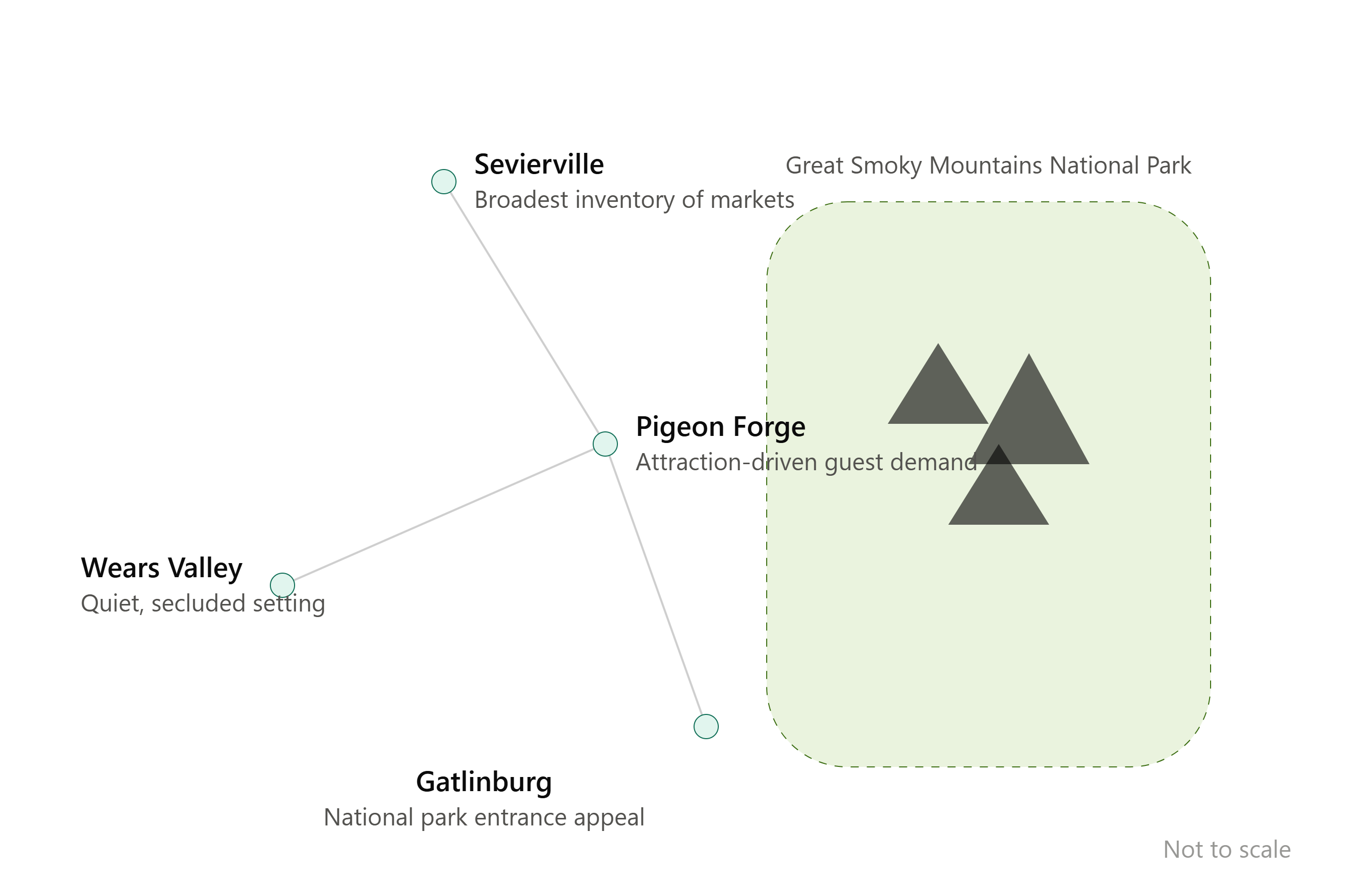
Sevierville, Pigeon Forge, Gatlinburg, and Wears Valley Are Not Interchangeable
Each of the four core Smoky Mountain markets has its own character, price point, and buyer profile. Sevierville tends to offer the broadest inventory and range of locations. Pigeon Forge benefits from steady attraction-driven guest demand. Gatlinburg carries National Park and destination appeal that draws a specific type of guest. Wears Valley offers a quieter, more secluded setting that appeals to a different buyer entirely.
Choosing a market should follow from your strategy, not the other way around. A buyer chasing maximum guest volume and a buyer chasing a quiet family retreat with occasional rental income should not be looking in the same place, even though all four markets sit within the same general area.
Ask for the Right Information, Not Just the Projected Income
Any rental projection you are handed is only as good as the assumptions behind it. Before treating a number as real, ask what it is based on: actual booking history from the current owner, a third-party estimate, or an optimistic guess. Request occupancy history, seasonal patterns, cleaning and management costs, and how the property has actually performed, not just what it could theoretically earn in a best-case scenario.
Income on a short-term rental can never be guaranteed, and any professional who promises a specific return should be treated with caution. The goal in due diligence is not to find a number you like. It is to understand the real assumptions well enough to make your own judgment, ideally with input from a tax professional, lender, or property manager who knows the local market.
What Actually Drives Guest Appeal
Views sell listing photos, but guest appeal is driven by more than that. Access and parking, bedroom and bathroom configuration, gathering and entertaining space, amenities like a hot tub or game room, privacy from neighboring properties, and proximity to attractions all shape how a property performs with actual guests. A stunning view on a property that is hard to access or awkwardly laid out can underperform a more modest cabin with a layout guests love.
It is also worth evaluating how easily the property "shows" online. Photos, floor plan clarity, and how the space is described all affect booking conversion, which matters just as much for an investment property as curb appeal matters for a primary residence.
Larger Isn't Always Better
It is tempting to assume more bedrooms automatically means more revenue, but larger cabins also come with higher purchase prices, furnishing costs, utility bills, insurance, cleaning fees, and maintenance demands. The better question is not "how big" but "does this property match demand in this specific location." A well-positioned smaller cabin can outperform an oversized property that costs significantly more to operate and doesn't match what most guests in that market are searching for.
The Expenses Beyond the Mortgage
A short-term rental carries a different expense profile than a typical residential purchase. Beyond the mortgage, buyers should plan for utilities, insurance, property taxes, professional management if you are not self-managing, cleaning between guests, ongoing repairs and maintenance, furnishings and replacement of worn items, amenity upkeep, platform fees, cash reserves for slow seasons, and any HOA or access-related costs specific to the property.
These costs vary meaningfully by property size, amenities, and management structure, which is exactly why they need to be confirmed for the specific home you are considering rather than estimated from a general rule of thumb.
Keep Resale in the Conversation From Day One
An investment purchase should still make sense on the day you eventually sell it, not just the day you buy it. Before closing, think through the future buyer pool for this type of property, whether the location and property type will still be in demand, and how the broader Smoky Mountain STR market has historically behaved through different conditions. A property that is a strong investment today should also be a property another investor or personal buyer would want down the road.
Regulations Can Change, So Verify Before You Rely on Them
Short-term rental rules, permits, occupancy limits, and local ordinances can vary by specific location and can change over time. Before assuming a property can operate exactly as advertised, verify the current rules that apply to that address specifically, rather than relying on what a neighboring property does or what was true when a listing was last updated.
Frequently Asked Questions

Which Smoky Mountain market is best for a short-term rental investment?
There is no single best market for every buyer. Sevierville, Pigeon Forge, Gatlinburg, and Wears Valley each offer different price points, guest appeal, property types, and ownership experiences. The right market depends on your budget, strategy, personal-use goals, and risk tolerance.
Can you tell me exactly how much a cabin will earn?
Income cannot be guaranteed. Available rental history and projections can be gathered and reviewed, but every assumption behind a projection deserves scrutiny, and buyers should consult qualified tax, lending, insurance, and property-management professionals before relying on any income estimate.
Are larger cabins always better investments?
Not necessarily. Larger properties may attract groups and produce more gross revenue, but they also cost more to purchase, furnish, maintain, insure, clean, and manage. The better question is whether the property fits your strategy and the actual guest demand in that location.
What expenses should I budget for beyond the mortgage?
Utilities, insurance, property taxes, management, cleaning, repairs, maintenance, furnishings, amenity upkeep, platform fees, reserves, and any community or access-related costs. Exact expenses vary meaningfully by property.
Can I use the property personally and still operate it as a short-term rental?
Possibly, but personal use affects availability and may affect financial planning or tax treatment. Personal-use goals should be coordinated with your property manager and tax professional before you buy.
Do short-term rental rules change?
They can. Regulations, permits, restrictions, and local rules vary by location and can change over time. Always verify the current rules for the specific property before relying on short-term rental use as part of your plan.
Can I use cryptocurrency to buy a Smoky Mountain investment property?
Yes, with planning that starts before funds move. Converting digital assets into Sevier County income property follows the same due diligence process as any other purchase, with an added funding layer to plan for in advance.
Chris Ball Properties at Keller Williams Realty
300+ career transactions, $125M+ in sales, and a 5.0 star average across 140 client reviews. Ranked #7 in Knoxville by transactions per 2025 RealTrends Verified. Tennessee License #346677.
Your Next Step
A Smoky Mountain cabin can be a strong investment or an expensive mistake, and the difference usually comes down to how thoroughly it was evaluated before closing. Start with your strategy, choose the right market for that strategy, and ask for the real numbers behind any projection before you fall in love with a view.
If you are early in exploring a Smoky Mountain investment, a consult is the natural first step. It is where your budget, goals, and target markets get sorted out before the property search begins. Call or text 423-765-5153 to set one up.