



Conversion in progress ...
Please wait while we generate your PDF
Buying East Tennessee Real Estate with Cryptocurrency

Plan the Structure Before You Start Searching
The purchase strategy should be defined before any assets move. That means getting clear on the target property type, price range, timeline, and how much flexibility you have around converting or transferring digital assets. A buyer who defines this early is in a much stronger position when the right property appears than one who starts figuring out the funding path mid-negotiation.
This planning conversation belongs with your real estate agent on the property side and with your financial, tax, and legal professionals on the funding side. The two tracks run in parallel, but they need to stay coordinated so a decision made in one does not create a problem in the other.
Chris has helped a client purchase four homes using cryptocurrency, so this process is built on transactions that actually closed rather than theory.
Documentation Is the Part Buyers Underestimate
Sellers, lenders, title companies, and attorneys may all require documentation showing the source, conversion history, and seasoning of any funds used in a purchase, and crypto-connected funds often draw more scrutiny than a standard bank transfer. Exact requirements vary by lender and by transaction, which is exactly why this is not something to figure out after you have already found the home you want.
Before you write an offer, it is worth confirming directly with the professionals involved what form of documentation they will accept, how far back they need transaction history to go, and whether there are steps you should take now to make that documentation easier to produce later.
Should You Convert Before You Search?
There is no universal answer here. Whether to convert digital assets before you begin house hunting depends on your timeline, financial strategy, tax position, volatility tolerance, and how the purchase will ultimately be structured. Some buyers convert well in advance to remove uncertainty from the process. Others prefer to keep assets in place as long as possible and convert closer to closing.
This decision sits squarely with your financial and tax advisors, not your real estate agent. What the real estate side can offer is clarity on your property timeline, so those advisors know how much runway they are working with when they help you decide on conversion timing.
Proof of Funds: What Sellers and Lenders Actually Want to See
Acceptance of crypto-connected proof of funds varies significantly by seller, listing agent, lender, attorney, and title company. Some will want funds already converted and seasoned in a traditional account before an offer is even considered. Others may accept documentation that shows a clear conversion trail. Very few will accept a wallet balance alone as sufficient proof.
Because this varies so much transaction to transaction, the right move is to confirm what will be accepted before you submit an offer, not after. Finding out mid-negotiation that your proof of funds does not meet a seller's requirements can cost you a property you were otherwise well positioned to buy.
Financing Without Selling Everything
Some buyers do not want to liquidate their full position to fund a purchase. Traditional financing, crypto-backed lending, or a mix of funding sources may be worth exploring depending on your situation. Each comes with its own terms, risks, and eligibility requirements, and this is squarely a conversation for a qualified lender and financial advisor rather than something to work out informally during a home search.
Timing Risk Is the Hidden Challenge
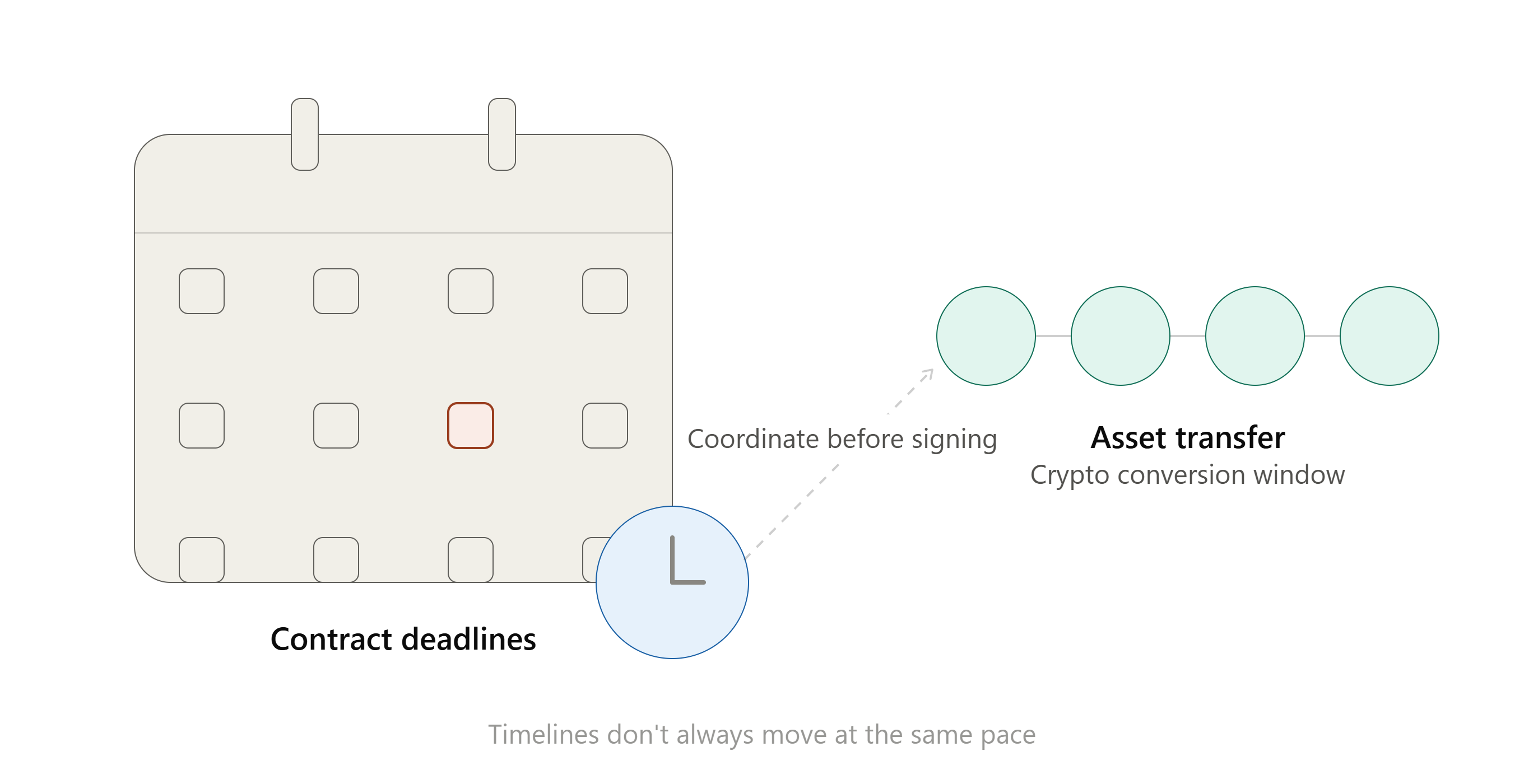
Crypto markets, wallet transfers, banking timelines, lender requirements, and real estate contract deadlines do not all move at the same speed, and that mismatch is where crypto-funded purchases most often run into trouble. A contract timeline built around traditional financing assumptions can put real pressure on a buyer who still needs to convert or transfer assets.
Coordinating early with your lender, title company, and financial advisor helps surface these timing gaps before they become a problem, rather than discovering them a few days before a contract deadline.
Tax Questions Deserve Their Own Conversation
Selling, exchanging, borrowing against, or transferring digital assets can carry tax consequences, and those consequences depend on your specific situation. This is not something a real estate agent is positioned to advise on, and it should not be treated as a minor detail. Before choosing a funding structure, it is worth having a direct conversation with a qualified tax professional about what a given approach could mean for you.
Keep the Property Decision Separate From the Funding Decision
It is easy to let the funding story drive the property search, but the two should be evaluated independently. A property purchased with crypto-connected funds still needs to make sense as real estate: the right market, a fair price, sound condition, and a future buyer pool that will still want it when it is time to sell. The funding path should support that decision, not distract from it.
Frequently Asked Questions

Can I buy a house with cryptocurrency?
Crypto may be used as part of the funding path, but the structure depends on the seller, lender, title company, documentation requirements, and how the assets are converted or transferred. The real estate side of that process can be coordinated, while the funding structure should be worked out with your financial and legal professionals.
Does the seller have to accept crypto directly?
A direct crypto transaction requires the seller and every professional involved to accept and support that structure, which is uncommon. Most transactions instead use converted funds, traditional financing, or a combination of funding sources.
Can I use crypto for a down payment?
Possibly, but lenders may require documentation showing the source, conversion, transfer history, and seasoning of funds. Confirm the exact requirements with your lender before writing an offer.
Should I convert my crypto before I start searching for a home?
That depends on your timeline, financial strategy, tax position, and volatility tolerance. This is a decision to make with qualified financial and tax professionals, informed by a clear property timeline.
Will a seller accept proof of funds from a crypto wallet?
Acceptance varies significantly. Confirm what form of documentation will be accepted by the seller, lender, attorney, or title company before you submit an offer, not after.
Can I finance a home without selling all of my crypto?
Some buyers explore traditional financing, crypto-backed liquidity, or mixed funding sources. Risks, terms, and eligibility vary, so this should be discussed directly with qualified lending and financial professionals.
Are there tax consequences to converting crypto for a real estate purchase?
There may be tax consequences when digital assets are sold, exchanged, borrowed against, or transferred. This should be discussed with a qualified tax professional before you choose a funding structure.
Chris Ball Properties at Keller Williams Realty
300+ career transactions, $125M+ in sales, and a 5.0 star average across 140 client reviews. Ranked #7 in Knoxville by transactions per 2025 RealTrends Verified. Tennessee License #346677.
Your Next Step
A crypto-funded real estate purchase works best when the planning starts well before you find the property. Define your target property and timeline, bring in the right financial, legal, lending, and tax professionals early, and let the property decision stand on its own merits once the funding path is clear.
If you are early in exploring a crypto-connected purchase, a consult is the natural first step. It is where the property goal and the professional coordination both get sorted out before you move any assets. Call or text 423-765-5153 to set one up.